
TERRACE | BEST IN LANDSCAPE LIGHTING | MAX your moment
Whether It’s a Tree or a Shrub, It Needs a Spot Light

Starting with Forrest Gump’s Tree
For many people, the first understanding of the deep connection between American homes and trees comes from that iconic scene in Forrest Gump—Tom Hanks as Forrest Gump, sitting quietly beneath a massive oak tree, waiting for the school bus and narrating his life. That tree is not just a set piece; it is a silent witness to the protagonist’s innocence, his waiting, and the flow of life.
This on-screen tree inadvertently became countless viewers’ introduction to the culture of the American family yard. It tells us that in the American residential ideal, a tree is not merely a plant—it is a container for memories, an emotional landmark, and an extension of the home.
Trees and Shrubs: The Dual Protagonists of Yard Narratives
As you watch more American films and shows, you’ll find that this “tree complex” extends far beyond a solitary large tree.
- Trees: Like the sycamore tree in The Fault in Our Stars that becomes a point of contention and reconciliation for the children, trees act as guardians, watchtowers, and vertical landmarks symbolizing growth and perspective. They provide shade and define the height and dignity of a space.
- Shrubs: In the garden of The Marvelous Mrs. Maisel or the yards of any suburban family drama, carefully trimmed azaleas, hydrangeas, and boxwoods form the soft borders and delicate textures of the yard. They bring color, layers, and privacy, serving as footnotes to a refined life.
Whether towering trees or neatly kept shrubs, together they construct the rich and three-dimensional green of the American residential yard. By day, they are gifts of nature; by night, their stories require light to continue.
When the Sun Sets: The Spot Light Becomes the Director of the Night
This is why a truly complete yard design always includes one (or several) spotlights. Their significance goes far beyond mere “illumination”:
1. Giving Plants a Second Life
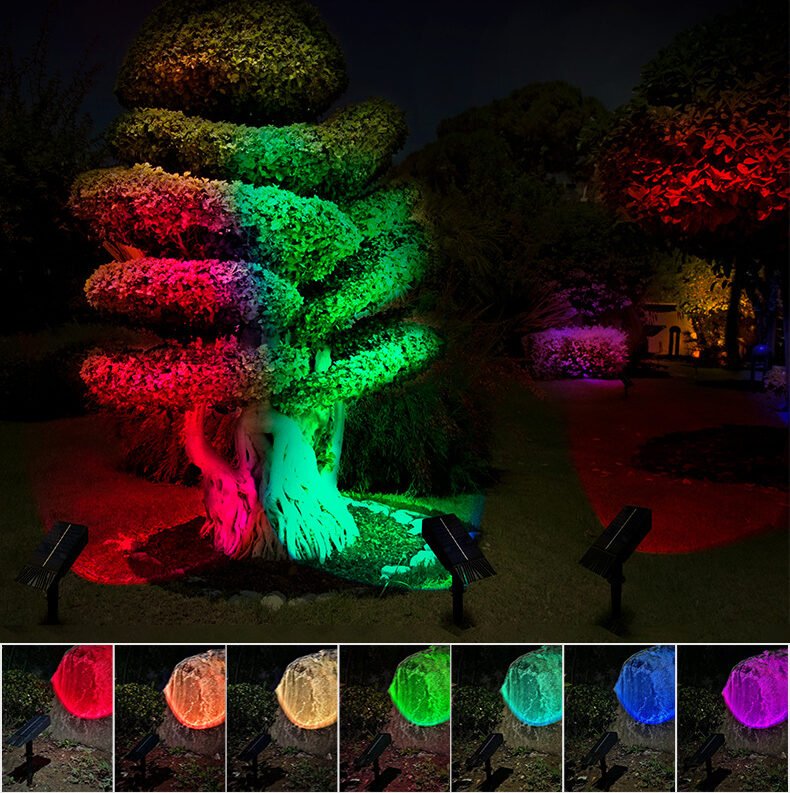
By day, sunlight is the sole director. By night, spotlights allow plants to become the stars of the stage. An upward beam of light can make the gnarled branches of an oak tree sketch a silhouette against the night sky, like an ink-wash painting; a sidelight can reveal the texture and layers of a hydrangea cluster. Plants take on a dramatic beauty at night that is entirely different from their daytime appearance.
2. Creating Poetic Pathways of Safety and Guidance
Functionally, spotlights can clearly illuminate walkways and steps to prevent tripping. But a more sophisticated approach is to use light to “draw” the path. Instead of brightly lighting the entire walkway, use a few low, focused spotlights to intermittently illuminate a few stepping stones or clumps of liriope alongside the path, creating a series of dancing pools of light like scattered moonlight to guide the way. This is far more poetic and intriguing than a row of uniformly bright path lights.
3. Extending Indoor Living and Defining Outdoor Rooms
Americans’ love for outdoor living is deep-rooted. The backyard patio is seen as an “outdoor living room.” Using spotlights to highlight a landscape tree or flower bed beside the patio is essentially creating a backdrop for this “room.” Where the light falls defines the boundaries and atmosphere of the space, making the yard at night equally a cozy place for living, dining, and socializing.
4. A Subtle Display of Taste
A well-designed, cleverly installed spotlight (often in a discreet bronze or dark gray finish, perfectly hidden among the plants) speaks volumes about the owner’s taste. It shows that the owner cares not only about the daytime landscape but also about the nighttime ambiance; that they not only enjoy nature but also know how to use technology humbly to enhance it. This kind of “invisible design” is precisely the hallmark of true sophistication.
How to Choose That Light for Your “Trees and Shrubs”?
- Use Light Sparingly: Less is more. Spotlighting one or two trees with the most beautiful forms or one or two key planting beds is far more artistic than flooding the entire yard with light. Allow darkness to remain part of the design.
- Hide the Light Source: The best spotlights are those that allow you to see beautiful lighting effects without spotting the source itself. Conceal them behind shrubs, beside rocks, or opt for in-ground well lights.
- Color Temperature is Atmosphere: Always choose warm yellow light in the 2700K–3000K range. This is the color of moonlight and candlelight—warm, relaxing, and natural for plants. It also attracts beneficial nocturnal insects like moths, creating a small ecological cycle.
- Incorporate Smart Technology: Dimmable, programmable, or even smart spotlight systems controllable via smartphone apps allow you to easily switch between “dinner party,” “gathering,” and “quiet night light” modes.
Conclusion: Light is a Love Letter to Plants
Forrest Gump’s tree in the film basked in the Georgia sunlight. In reality, when we finish a busy day, the time we truly get to spend with our own yards is often already night.
At that moment, a well-placed spotlight is the gentle glance we cast toward those silent companions. It is a relay of the daytime sun, a tribute to the stature of trees and the lushness of shrubs, and a reminder to ourselves: Life is not just about the busyness of day; the peace and poetry of the night are also worth cultivating.
So, whether your yard features a towering oak symbolizing heritage or tidy shrubs representing refinement, remember to reserve a spotlight for them. For what it illuminates is not just the plants, but also the subtle and profound emotional connection between you and your home, nature, and the night sky. When the lights come on, the second chapter of your yard’s story truly begins.